Thursday
Jan082026

Excerpt from Clay Bodies

“Death is only an old door set in a garden wall.”

— Nancy Byrd Turner


I scan three evenly-spaced hooks on the hall mirror that collect the household keys.

We almost drove off without it: the key to the Garden of Memory, without which we would be wasting a trip.

Thanks for reading Poetry, Prose & Pottery! Subscribe for free to receive new posts and support my work.

It’s been at least a decade since we last made the hour-long drive to Forest Lawn Memorial Park in Glendale, long enough that I’d forgotten what the key looked like. My younger self must have predicted this, folded the blue, red, and yellow child’s name sticker on its head, connected it to a Marvelous Mom keyring, knowing this day might come.

I text Mom a picture: “Found it!”

My husband Lloyd backs us carefully out of the driveway, Mom and I riding in the second row chatting and directing our “chauffeur.”

Forest Lawn was the site of regular family picnics in Mom’s childhood. It’s where her father, Brad, is buried, behind an impenetrable locked door in that “garden of memory.” Great-Grandma Mary, Great-Grandpa Rufus, Uncle Bud, and Great-Great-Grandfather Burr all share a tiny vault in the Great Mausoleum, like the entire family squeezed into an efficiency apartment.

When Mom’s dad died, her older brother, Brad Jr., was just sixteen, and middle child Pat was ten. Mom, the baby, was only four. After Brad’s death, the family would take a picnic and lay out blankets around the little lake with the heron fountain, right near the main entrance. As Brad Jr. and Pat married and their families grew, the smallest kids would entertain themselves by chasing the swans and ducks. Uncle Brad had a home movie camera that he wielded mercilessly. In one series of frames, Mom leans toward a big white duck with an open palm, then looks up with a broad smile to wave at her older brother behind the camera, Mom already recognizable as Mom. Nearby, one of Mom’s cousins—which one? Shari? Or Christie?—steps back from an aggressively approaching swan. It’s a series of jump cuts then, first to the Gardens of Memory, then to the various other statuary around the perimeter, then back down to ground level, zooming in on Grandpa Brad’s headstone, and finally on to the Court of David, lingering on the stark white marble figure.

These are some of her happiest memories, she says.

When we were here last, my Bradley, Grandpa Brad’s namesake, played leapfrog over the grave markers and refused to sit for a picture. Both sons, now young adults, had exactly zero interest in joining us today. Maybe in another decade we can try again, but by then Mom will be 83 and I will be 60, and who knows if the world will even still exist. But every generation thinks that, hallmark of getting old. Now that I’ve turned the corner on fifty, I’ve outlived the ages of both Grandpa Brad, 39, and Great Grandpa Rufus, 49.

The closer I get to my expiration date, the more alive the dead feel to me.

Lloyd makes a right, then another right, and now we’re on Cathedral Dr., passing through the impressive wrought iron gates and past the pond and the storybook tudor and brick mortuary, the Little Church of the Flowers, following the circuitous route to find The Court of David, our landmark.

In the courtyard, we are just children, Mom and I, giggling about the Statue of David’s gigantic penis. We pose beneath him for a photograph: me in my denim skirt and straw hat, and she in her striped thrift-store palazzo pants and brocade bag.

David stands on a pedestal in the courtyard in the Center of a star—elbow crooked, hand to his chin, lost in thought. He doesn’t seem as tall as I had remembered him, and something else seems off. I pull up the photo app on my phone, scroll to find our photos from eleven years ago. And there he is—huge, stark naked, marble-white.

Why is he green now?

David’s courtyard is walled, each segment inset with a bas-relief sculpture and tablet inscribed with a corresponding story: David and Goliath, Michelangelo’s Studio, the 23d Psalm. There is an opening to our right, a path to follow. We take it and enter The Garden of the Mystery of Life.

With his hands folded behind his back, Lloyd’s head is lowered, reading the ground-level tablet explicating a sculpture depicting eighteen figures at different ages and stations, all peering down at the Mystic Stream of Life. The inscription invites viewers to see themselves among the figures, asks the question, Gentle reader, what is your interpretation? I don’t relate to any of them, except maybe the slow turtle on the bank that the small boy on hands and knees is closely examining. The mother of boys, I can imagine him, on a whim, picking up the turtle and throwing it across the courtyard.

*

A brief detour into the world of Forest Lawn.

Forest Lawn was created by a guy named Dr. Hubert L. Eaton in 1917, who had the brilliant idea to combine a park-like setting with a cemetery, because who wouldn’t want to lunch in close proximity to the dead?

Within the Courtyard of the Garden of the Mystery of Life, there is a set of weathered copper double doors. Grandpa Brad is the odd man out, the only member of our family buried in the ground at Forest Lawn.

A turn of the key and we are in.

To our right is ‘America’s Sweetheart,’ Mary Pickford, in a family crypt decorated with cherubim and fruit. There are other famous people here too, though we don’t know where.

The grassy expanse is long and wide as a football field, punctuated by row upon row of grave stones like a series of dashes. Some have clever quotes and laser-etched photographs. Not Grandpa Brad’s. His is plain, with only his name, years of birth and death (1913 and 1952, respectively) and the phrase Beloved husband and father. 

Mom, fingers laced, stands beside the stone, flip flops flattening the grass. We pose here for a photograph: two generations above ground, one below.

We linger until she’s ready to leave, which is longer than I’d planned but shorter than she’d stay if she could. Lloyd has gravitated to the other end of the lawn, looking back as if herding us toward the exit.

We turn to go, because we still have another stop.

To “see” the rest of the family requires driving to the Great Mausoleum, which is in fact great and even a little bit spooky: immense and impressive as a castle, but not in the cloying Cinderella castle way; more like terrible Castle Bran in Romania, with arches and spires and made entirely of steel-reinforced concrete. Why they call this place the “Disneyland of graveyards” is beyond me.

Double doors from the parking lot open onto a cavernous interior cool as a cave. A security guard is seated in a booth behind glass. I address her.

“Hi, we don’t know where we’re going.”

The guard gives me this look like, don’t you waste my time. Lloyd gives me a cringey look the equivalent of a face palm but I keep going.

“Our family is interred here. Keeler. Rufus Bradley Keeler. Can you please tell us how to find him?” The guard’s fingers move across her keyboard. The screen lights up with the information we need. She jots down a number on a scrap of paper thrust in my direction, waves her arm as if to say, that way.

*

“I think I know how to get there,” Mom says, and we follow because what else is there to do but trust that she knows the way.

The halls are churchy, lined with antiquities–faux? The focal point is a backlit stained glass replica of “The Last Supper” which takes up the entirety of the far wall. Even to me, a non-believer, the faces of Jesus and his disciples are reverential. Then I spot a name recognizable to few except for those familiar with Riverside’s Mission Inn, or of a certain generation: Carrie Jacobs-Bond, songwriter, commemorated with a bronze plaque of a woman at the piano framed by stage curtains, a ribbon of music rising up. With her is the adult son who predeceased her, and briefly I consider the grief that accompanies outliving your child.

I look up to see that Mom and Lloyd have moved on without me.

At the foot of the entrance to Columbarium of the Sanctuaries, I pause to snap a picture of my feet with the inset stone marker. I want to memorialize this so that it will be easier to find next time.

The word columbarium comes from the Latin word for pigeon, columba, and quite literally means “pigeon house.” Our family’s pigeon house is just inside and to the left of the entrance, first column on the left, a few rows up from eye level. I make note of these coordinates. This wall, our wall, is within the “no public access” section of the mausoleum. There are ninety-four other family niches, most larger and more ornate, some even behind glass, visible but just out of reach.

I am reminded of the world of ways one can keep the dead.

Grandma Vi kept Grandpa John, my dad’s dad—really, his stepdad—in a styrofoam ice chest in the garden behind their mobile home, where she could sit with him outdoors.

Every niche here, in the Columbarium of the Sanctuaries, has a little bud vase. In spite of having a florist for a sister, I gave no thought to bringing flowers today.

There is a photo in the family album of a fluffy white pigeon perching calmly on my Grandma Catherine’s hand, its own wooden “pigeon house” just visible in the lower corner. Her face is out of the frame, but I know it is her–one arm outstretched, hand open, palm up, cupping its claws. Nothing is preventing the pigeon from lifting off.

There is an often-told family story of how, at the home in Glendale, a dog – whose? – managed to get a hold of one of their pigeons and tore open its breast. Calmly, Brad told Catherine to wait while he ran and got a needle and thread. Then he gently sewed it up. The bird lived. This must be the bird, all puffed up, dapper in his white feather coat.


One last stop before leaving Forest Lawn. Yes, a mausoleum museum and gift shop.

And here I find the answer to the why of the green David.

A white marble replica of David’s head lay on its side, eyes wide, pupils fixed, like the head of Holofernes. I read the plaque.

Created by Italian artist Oreste Andreini in 1937, this “original” replica—not even the one I remember from my last visit with Mom, but the one before it—was already brought down by the time I was born by the 1971 Sylmar earthquake. Over time, five more replicas would fall. After having learned their lesson, this last replica is cast in immutable bronze.

Nearby stands the severed marble stump of David’s foot.

Mom balances like a flamingo beside it, raises her right leg forward to compare her own size six flip-flop-clad foot. The top of the ankle comes to her waist–just the right height for her to steady herself, oblivious to the sign that says, “Please do not touch,”

I point the camera and shoot.

Wednesday
May212025

More Research On the Road: Lincoln Part 2 (mostly pictures!)

So picking up where I left off, I was in the office in Gladding, McBean, talking with Lori Pantel, and I told her I was writing a book about my grandfathers, one of whom worked there as draftsman in Lincoln. She’d never heard his name, and while I couldn’t just drive around the property I could pull up to the employee parking lot if I wanted to get a photograph of the iconic GMB building. But before we left the office, Lori let me know that GMB had just celebrated its 150th anniversary. She handed me a commemorative calendar in a sealed paper envelope. I tucked into my bag and we went on our way.

Here is that building, where Rufus most certainly worked:

I also was fascinated by this building that had clearly long ago been abandoned and taken over by trees:

While we were in Lincoln, I wanted to find a particular house at the corner of D and Fourth Streets, now McBean Park Drive. Countless hours of searching Newspapers.com turned up this clipping of a house that Rufus designed for one of his colleagues at GMB.

While the roofline has been altered—and after one hundred years, of course things have been updated—but the bones of the house are intact. The porch, the window placement including the bay window, the chimney. The flowery language of the newspaper clipping is a bit over the top, but it would have been fun to see the house in its heyday. Among the structures I have evidence that Rufus designed, there are the house he and his father lived in in South San Francisco, this house, The Rose Theater in Roseville, and his own house in South Gate.

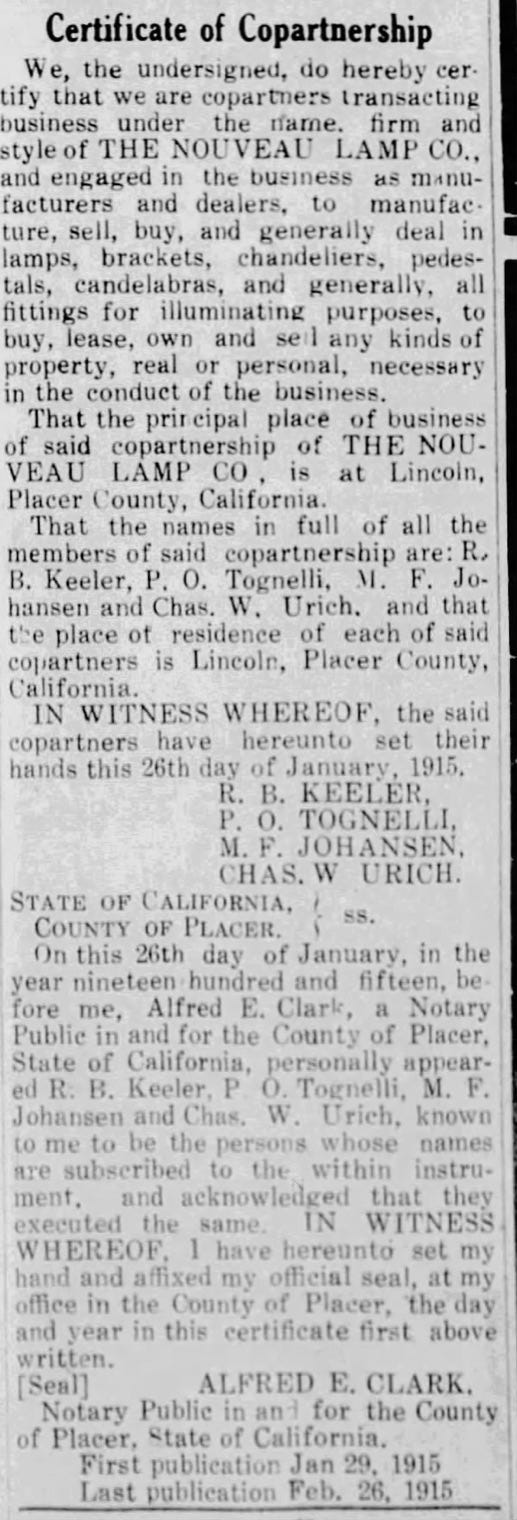
As for who this man was that Rufus built a house for, P. O. Tognelli, M. F. Johansen (who would later replace Rufus as the head draftsman for GMB after Rufus resigned), and Chas Urich were copartners with Rufus in a business venture, the Nouveau Lamp Company. All four men worked for GMB. I don’t know much about these other men.

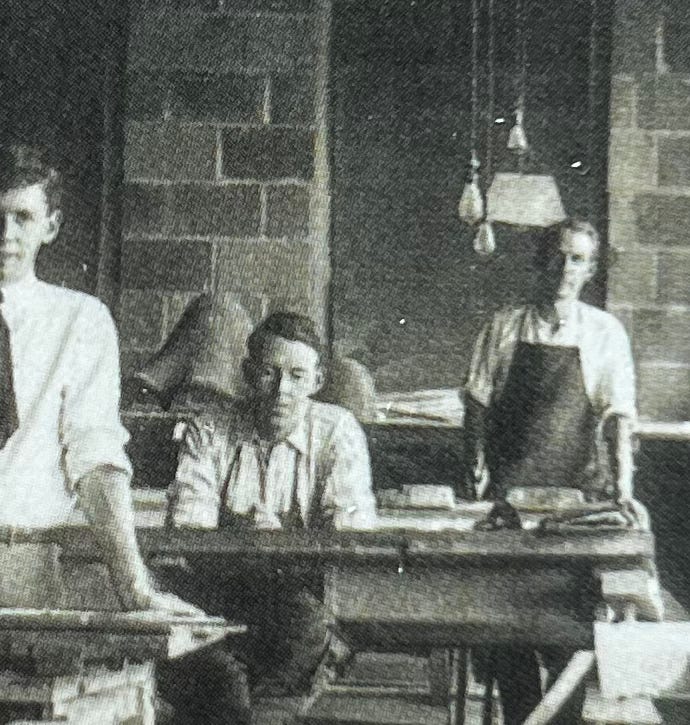
So the last piece of exciting revelation was this: When I later opened the calendar, I flipped through it hoping for more historic photos and was disappointed that most of them were contemporary. But when I took a closer look at the cover, I discovered that there was Rufus, sitting at a drafting table, arms folded.

I have since called Gladding, McBean and had a nice conversation with Jamie (whose office is in what was formerly the drafting room) and she is trying to track down the digital image for me. I hope to be able include it in my forthcoming book. In the meantime, here is the cover of the calendar, and a detail.

So that’s it for my Gladding, McBean journey for now. Next up: Carnegie.

Wednesday
Apr232025

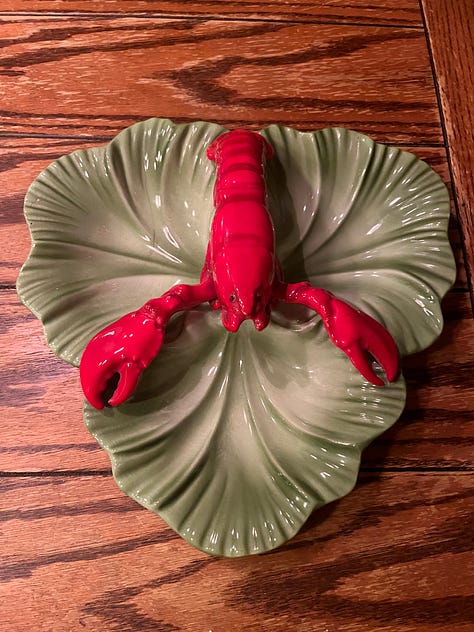
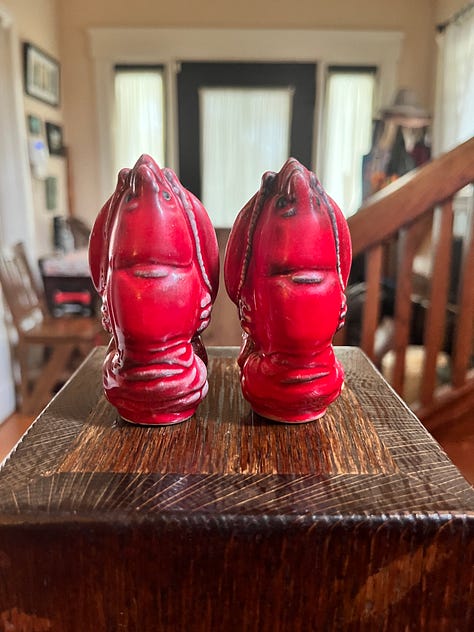
Brad Keeler's lobsters

I know I promised a Part 2 for the research road trip and I'll get there, but today I just want to quickly share a couple things I found at an antique store in Escondido.

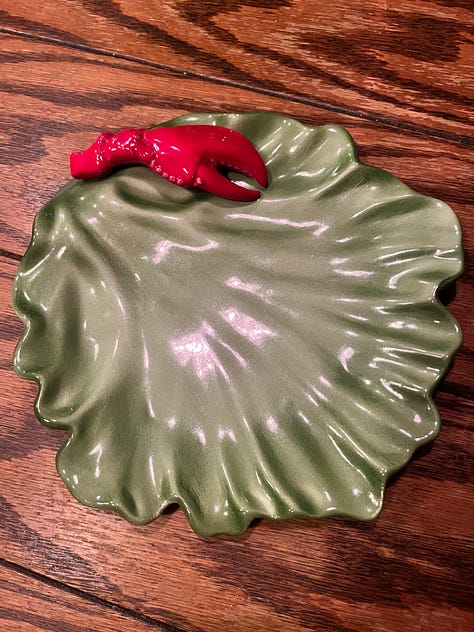
These two lobster plates were placed together on a shelf. At first glance, they look a bit alike, don't they?

But they're not.

Can you spot which one is Brad Keeler and which is not?

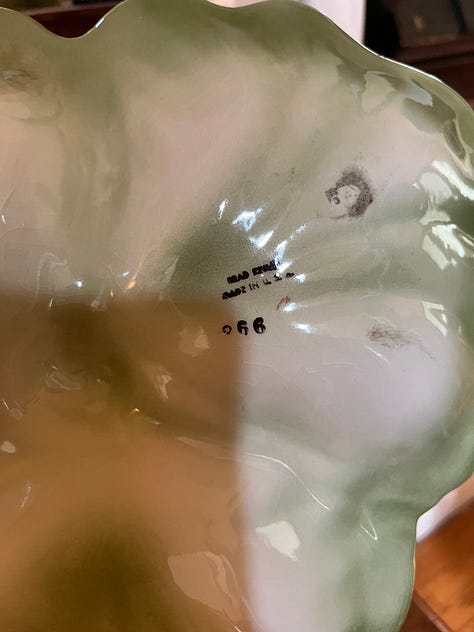
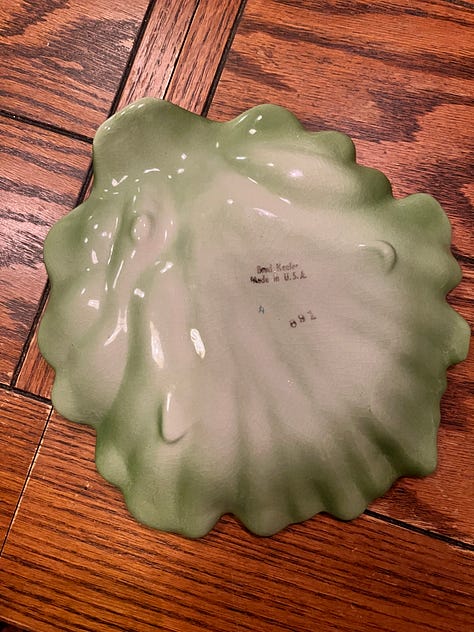
Yes, you guessed it, the one on the right--the big one--is the real deal. The small one, on the left in my hand, is not. How do I know?

First, look at the cabbage leaf. The striations are too straight. All of the Brad Keeler ones have a curvature to them. 

Second, the green glaze is wrong. All of the different makers have their own forumulas so you can spot the difference between makers just by the colors alone. The Keeler ones I'd describe as more of a grass green. The one on the little plate I'd call closer to a hunter green, and notice too it is graduated and mostly white with just the green around the edges. The lobsters themselves? Those reds are pretty darn close but the detail of the smaller one is not quite as detailed as Keeler.

Lastly, the bottom of the plate. Keeler lobsterware doesn't have the little feet you see here.


These are things I've just learned through observation. These are not specialist knowledge. But I do want people to be able to distinguish between the real thing (in my opinion, nothing compares to Keeler) and everyone else. 

Look for overall detail and glaze color. If you have a smart phone, look it up on eBay to compare. (But beware that eBay isn't always right.) 

As for the larger piece? I didn't end up buying it, though it was a close call. It was badly damaged and glued back together, with some other significant chips. The price was good for a damaged piece--$39--considering there's one just like it on eBay selling for $195. But I already have at least one good specimen, and I'm running out of room store them.

I bought a special case for my lobsterware. As you can see, I'm pretty maxxed out!


Saturday
Apr052025

Taking Research on the Road: Part 1: Stockton, Sacramento, Marysville, Lincoln

Cross posted on Poetry, Pottery, and Prose.

___

Today, my latest submission for the Inlandia Literary Journeys column published, which I titled, “In Praise of the Research Road Trip”. I’ve done a lot of that for Clay Bodies. From finding where my grandparents lived in Laguna Beach to visiting the Capistrano factory site to discovering the location of the Bullock’s bust in a Macy’s in Pasadena, everything is made more tangible when the physical properties of a thing are able to be observed. How heavy is it? What was the view from the living room window? What was the actual footprint of the factory? What kinds of trees and birds are there? Sometimes there are barriers to discovery. The house obstructed by a guard shack. Incomplete records. Only a partial address. You get the picture.

But it’s worth it.

Some names to refer to as I dig in:

  • My mom’s dad is Brad. Brad’s dad is Rufus. Rufus’s dad is B.B.

  • Rufus’s wife is Mary Leary. Her sister in law is Josephine Leary, and it was her hotel where Rufus was staying when he met his future wife.

  • Rufus’s mom is Mary Simpson.

Stockton

Some lessons learned: Check the opening and closing times of places you want to visit. We rolled into the San Joaquin Catholic Cemetery at about 4:23pm. The cemetery closes at 4:30pm. I convinced the security guard to let me through and I used GPS to lead me to an area I hoped would be near Josephine Leary’s grave, but alas, it was not. Chalk that one up to not doing my homework. Onward.

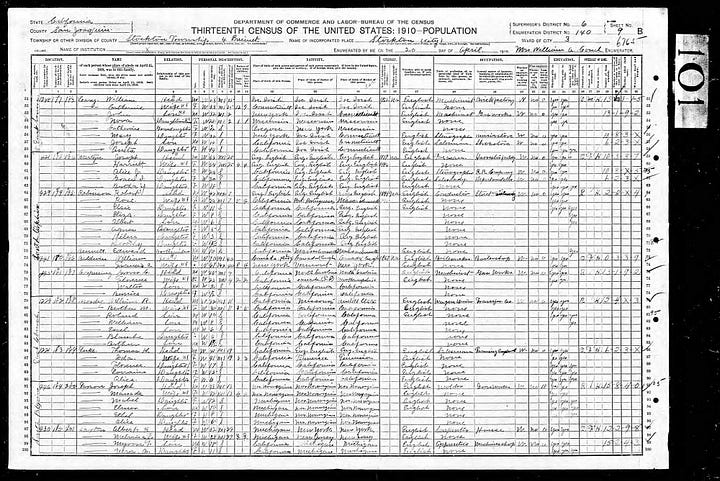
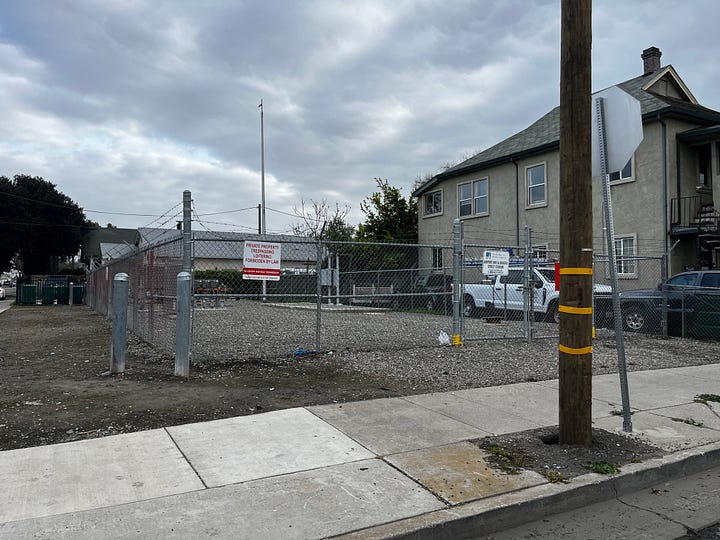
Next, I wanted to find an address from an old census record, 1248 East Sonora, the Leary household where my great grandmother Mary Leary lived before and likely right after she married my great grandfather Rufus. At first I thought perhaps the neighboring house was it but despite being broken up into four units, it seems more likely that the address belongs with an empty lot next door. Nevertheless, I considered this a success. This wasn’t a major stop on my list, but I was glad to have tried. I’d looked at Google street view and couldn’t get a clear view of the addresses.

Location of the Leary family home in Stockton.


Sacramento

On a free night in Sacramento, Lloyd and I checked out Old Sacramento Waterfront. Specifically, I had wanted to see the Delta King, a permanently docked steamship that with its twin the Delta Queen used to make daily runs between San Francisco and Sacramento. Before we booked the Airbnb, we booked the Delta King, but then chickened out and canceled because of some of the reviews. Some said the quarters were too tight, or the walls too thin, or a lack of privacy. I’m a little sorry we switched, but glad we managed to take a look and grab dinner on the ship.

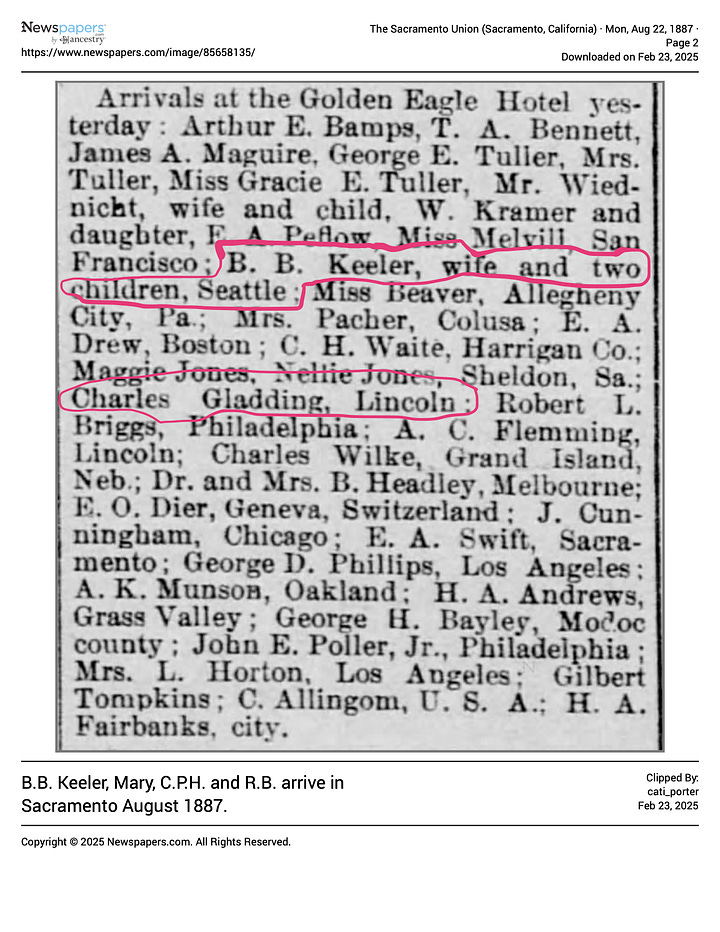
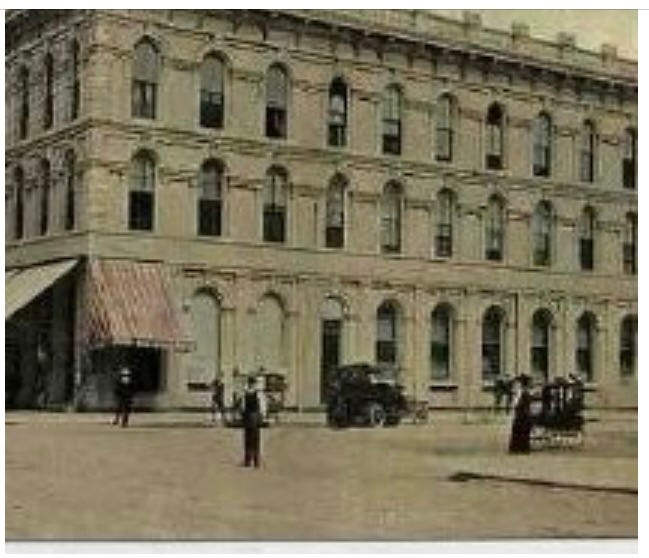
Rufus was born in Bellingham, Washington. According to a newspaper clipping, when he was about two years old, his family—father, mother, and older half-brother Charles—arrived in California from Seattle to stay at the Golden Eagle Hotel. I speculate that they traveled by steamship but it’s also quite possible that they took the train. The reason I lean toward steamship is that it’s docked immediately adjacent to K street, which is a straight shot to the Golden Eagle hotel, located at the corner of K and 7th streets. The train station, on the other hand, is on I street, and so I speculate that had they taken the train they might have chosen a hotel closer to the station. It couldn’t have been the Delta King or Queen themselves, though, because they weren’t christened until 1927. As for the fate of the Golden Eagle Hotel, we made several laps around the block where it should have been, and determined that it was long gone.

One fun fact I had previously overlooked: Also arriving at the Golden Eagle? A Mr. Charles Gladding of Lincoln, e.g. baby Rufus’s future employer.

Baby Rufus arrives with dad B.B., mom Mary, and older brother Charles.The Golden Eagle Hotel in Sacramento. Picture found on Calisphere.


Marysville

One of the biggest mysteries in researching my grandfathers has been, who was Rufus’s mother? In the process, I’ve discovered that Rufus’s father was married twice, and that his mother was the second wife. Making it a bit harder to parse, though, is the fact that both women were named Mary Ellen. (As was Rufus’s own wife…)

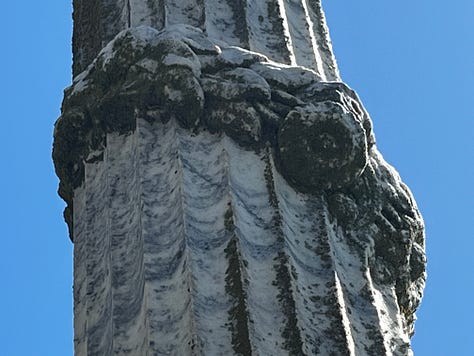
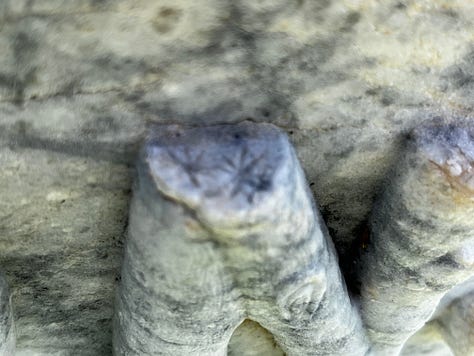
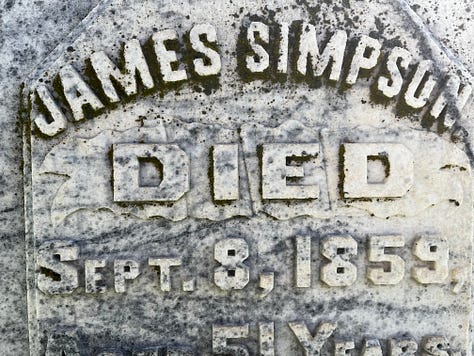
Mary Ellen Simpson was raised in Marysville, where the Simpsons made their home after crossing the continent. In fact, there is a Simpson Lane, a Simpson Bridge, and there once was a Simpson Ferry. Mary’s father James was killed in a gunfight. The Simpsons were part of Rufus’s roots, and therefore mine, so a stop in Marysville seemed appropriate. We drove down Simpson Lane, across Simpson Bridge (neither of which have any current signage) and we found James Simpson’s grave in the Historic Marysville City Cemetery, the first city-owned cemetery west of the Rockies, where I noticed a soggy notebook someone else had left behind on a bench. Small details. I also was able to get a close-up look at the grave monument and the moss (lichen?) that had built up on its surface over time, and wonder about the many hands that had worn away some of the surface of the stone.

Detail of scroll work with lichen/moss.
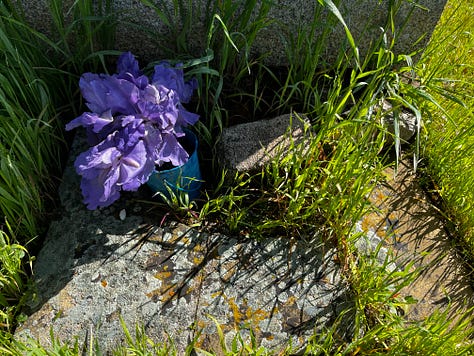
Detail of the top of the M in Simpson.Detail of the engraving on the monument.Foot of the monument with silk flowers.
Me with the monument.


Lincoln

Marysville was the furthest out. We went there first, and then worked our way back. After we left Marysville, we drove to Lincoln, home of Gladding, McBean. Remember that guy Charles Gladding from the Golden Eagle Hotel in Sacramento? He was so impressed by baby Rufus… Okay, no, that’s not how it happened. I have no idea how it happened. But what a coincidence! Charles Gladding was the founder of Gladding, McBean, initially a manufacturer of clay sewer pipe but also architectural terra cotta and tile. I knew Rufus had worked here and I wanted to see it in person, so I said, “Hey Siri, directions to Gladding, McBean in Lincoln”. So she took me literally. And we went to the heart of the operations, probably where no civilian is supposed to go.

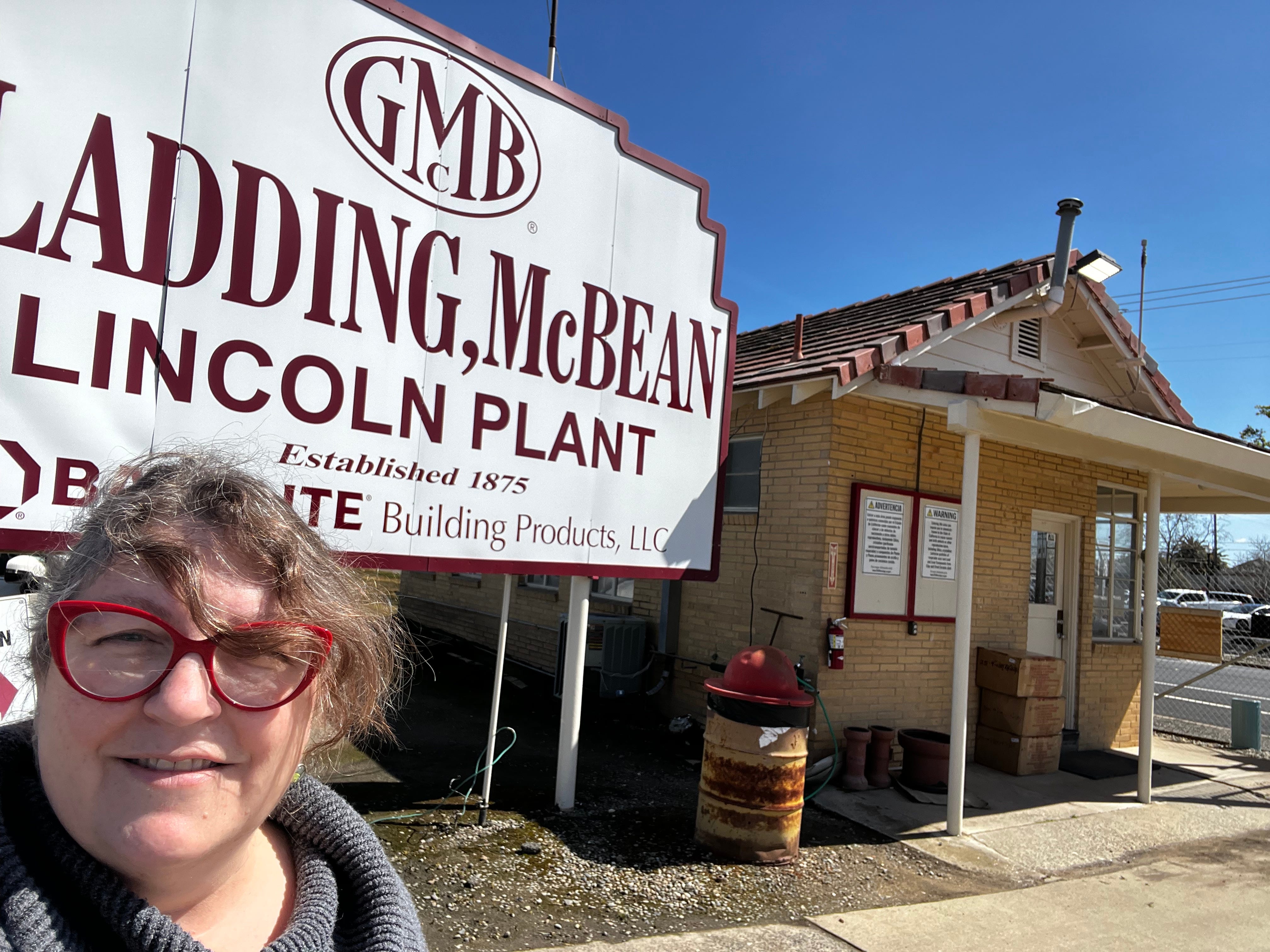
We finally made it around front to the main entrance.

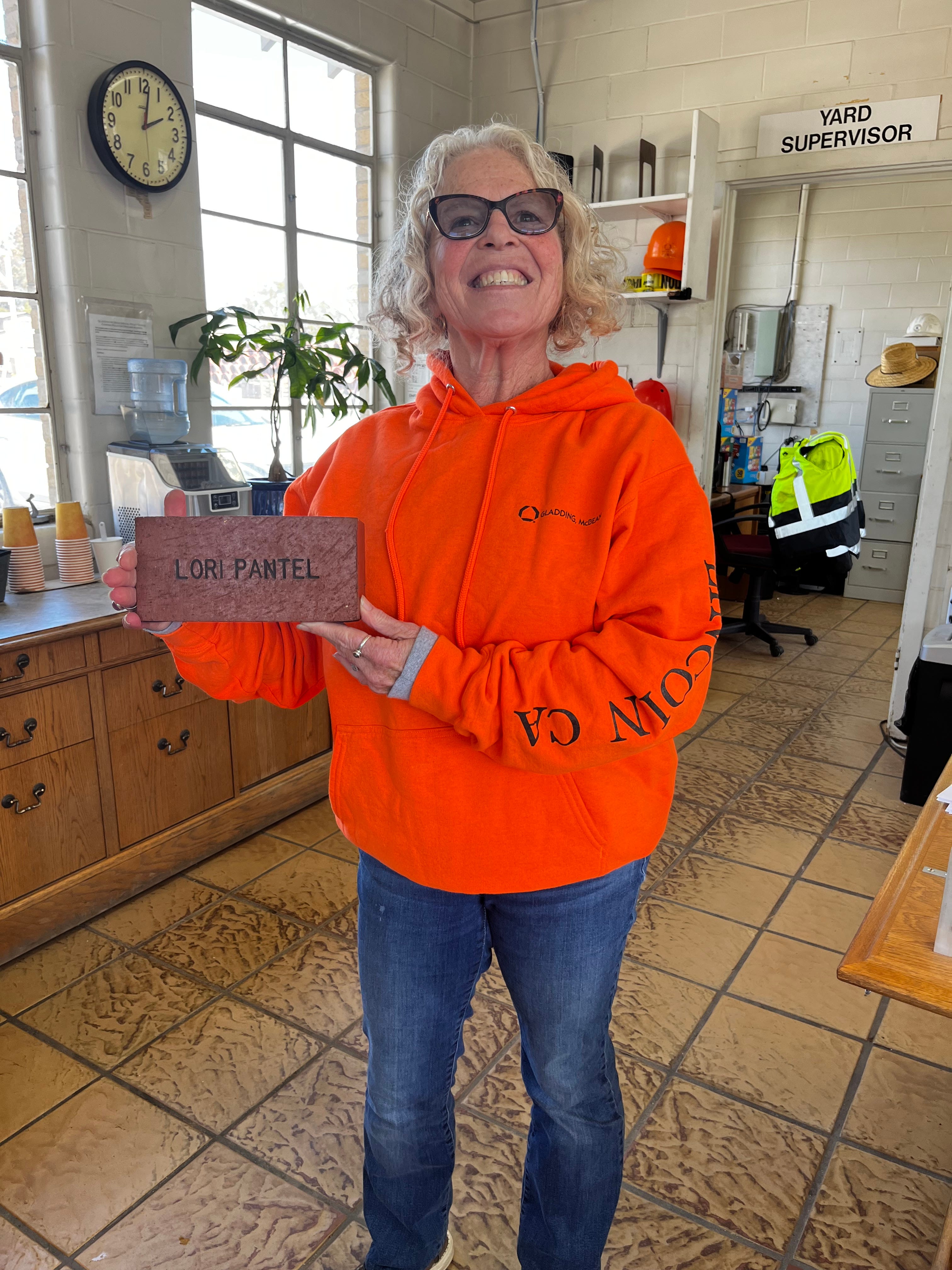
I went inside the office and asked if we could look around and met their very nice office clerk Lori Pantel. I noticed she had an engraved brick on her desk so I asked if I could take her picture with it. So neat!

I’m going to end for today. Watch for Part 2 which contains an amazing discovery.

Saturday
Feb082025

Naming the Dead: Chapter 3 in draft, Clay Bodies

Below is an excerpt from Clay Bodies. [Cross posted on Poetry, Prose & Pottery]

Above: A portrait attributed to Mary Ellen Keeler neé Simpson, Rufus Keeler’s mom.

Naming the Dead

2023. Riverside, California.

Some family stories lodge in the brain like a burr. What part of the story is fiction and which is fact? What makes them true is the extent to which they are repeated, but like that telephone game, the more they’re repeated, the more they change.

Who was Great Grandpa Rufus’ mother?

That has been a persistent question for me as I have been researching. Not only have I wanted definitively to know what her name was, but also: Who was she? What was she like? What did she like? Where did she come from?

From the website behindthename.com, the name Mary stems from the ancient Egyptian word mry meaning beloved, or possibly mr, meaning love, later translated into Hebrew as Myriam, Moses’ sister, then Maria, and finally anglicized to Mary. The name Ellen is the Medieval English derivative of the Greek Helen, meaning torch, or possibly even moon. Helen was the daughter of Zeus and Leda. Together, Mary Ellen means something akin to beloved light. The two stories—Moses and Miriam and Zeus and Leda—rub up against one another in my kin, .

I’ve taken my clues as I can find them, and they all lead back to one name, but three different people, all named Mary Ellen.

All three play crucial roles in this story but only one is Rufus’ mother, and another Rufus’ wife. The third, no less important, is more of a walk-on, but still—she is an important figure.

It doesn’t help matters that Rufus’ mother is an enigma. Nobody talked about her. There were whispers. Did she run off? What happened to her?

How to peel apart the different Mary Ellens?

To answer this, I turn to ancestry.com and dig through census data, city directories, marriage records, but instead of answering my questions, they dredge up new clues, like this scandalous piece alleging the “trading of wives.”

The headline reads, “How a New York Capitalist Married a Divorced Woman.”

It appears in the San Francisco Examiner, Monday November 29, 1886, in which it is called “the latest sensation from across the bay” and a “compound complex marriage and divorce arrangement,” the article tells of two men, Charles T. Hickok and B. Keller (sic), their friendship, and the dissolution and subsequent reconstitution of their marriages.

Some true stories have the ring of fiction in the retelling, and so it is with the entanglement of the Hickoks and Keelers and Bleuels and Simpsons, but I believe I’ve unearthed enough facts to corroborate at least a basic outline of the story, in spite of their misspelling of our family name.

Rochester, New York, was a burgeoning modern city, and 1850 was a census year. Charles Theodore Hickok and Bradley Burr Keeler (or Burr Bradley, as he seemed to prefer, B.B. for short) — perhaps new each other as children, both living in Ward 4 during the census taking. Mary Ellen Bleuel’s family lived in Ward 6 in 1860 and then Ward 13 in 1870.

At the time of the census, B.B.’s father, Rufus E., is officially noted as a “farmer” on the census, but to my reading, and based on other information I’ve gleaned, it may and likely does read, “tanner.” He worked in leather, becoming a prominent local businessman and real estate investor before he is the first named Fire Captain, and then later he will spend a year as Mayor of Rochester. At age sixteen, B.B. enrolled in the University of Rochester and studied on the Bachelor of Science track for two years before enlisting in the Union Navy as a landsman on several Naval gunboats for another year. After his discharge 1863, he returned to Rochester and working for his brother-in-law in the tobacco business, and in February of 1875 B.B. marries a hometown girl named Mary Ellen Bleuel, daughter of a Swiss carpenter and French mother, in a Manhattan courthouse wedding. For the first few months of marriage, they live in the Keeler family home on S. St. Paul in Rochester along with B.B.’s mother along with sister Natalie and brother Theodore Valleau “T.V.” and wife Ruby.

Upon his father’s death, and concurrent with his marriage, the newlyweds set off for California in search of the land of milk and honey as written by the eminent journalist and non-fiction author, Charles Nordhoff, grandfather of the other eminent author Charles Nordhoff who authored the classic Mutiny on the Bounty. The elder Nordhoff, author of the railroad-sponsored travel guide, “California: For Health, Pleasure, and Residence,” could be said was almost singlehandedly responsible for the influx of settlers to the west coast, save for the 49ers who had settled in the Gold Rush area. Nordhoff’s depiction of scenic California enticed cold Northerners to make their way to the more temperate California coastline

By now the Bleuel family has relocated to Carpinteria, California, and they are farming. The newlyweds B.B. and Mary Ellen follow. B.B. buys farmland too, and further, he shares title with his wife—an unusual maneuver for the day. The census records note the Keelers, while in Carpinteria, had a Chinese servant named Foo. The next year, B.B. returns to Rochester to retrieve T.V. and Ruby via steamship, and, afterwards, both Keeler households move to Santa Barbara where T.V. opens a furniture shop.

But then a curious thing happens. Within five years, the furniture store goes belly up and T.V. and Ruby move back to Rochester. A news item in the Santa Barbara Daily Press writes,

“Some people who are prone to say mean things intimate sometimes that Mr. Keeler has done more for the town than the town ever did for him, but of course such people are slanderers, in a certain sense. We have Mr. Keeler’s own word for it that he will return here in spirit just as soon as he is killed by lightning, and will have a pleasant word to say to Col. Hollister and Uncle Warren Chase.”

Chase, by the way, was the editor of the newspaper, and Hollister financed the paper, among other ventures.

According to census records, B.B. was by turns a bookkeeper, merchant, farmer, contractor, speculator, and capitalist. Always trying to get ahead, B.B. makes regular trips to Mexico, begins a coconut oil extraction business.

In March of 1882, B.B. makes a land purchase in Santa Barbara that includes a claim to oil, and he is now the vice president of the Santa Barbara Oil Company. During this period, he sells the farm and has gone all-in for commodities - oil, and now a gold mine.

Also, in 1882, he became two-tenths owner of the William Arthur Mines, a goldmine.

In Marysville.

In a parallel story, Charles’ father Benjamin Eldridge Hickok has been running a boarding house that holds thirty-plus other people including women and teenagers, many of whom are young immigrants who either work as laborers or presumably hold positions within the boarding house itself. Charles would have been seven at the time of the 1850 census, the same age as B.B.’s older brother T.V., so it is my best guess that Charles knew B.B. through T.V., although this is pure conjecture. Maybe they played together at school, or on the street; maybe they knew nothing of each other until much later, bonding over a shared hometown finding themselves in a new shared city in a faraway state called California.

Forty miles north of Sacramento is Marysville, the Yuba County seat. An entryway sign reads, “Gateway to the Gold Fields.” Established midway through the 19th century, it is situated in the heart of Gold Country in the vicinity of Sutter’s Mill where the ‘49ers migrated to make their fortunes during the Gold Rush and named for Mary Murphy, one of the surviving members of the Donner Party.

Around the time of the city’s founding, while still in his teens, Charles and his family move to Marysville, where his father buys another motel. Beyond motel keeping, the Hickoks venture into flour milling, purchasing the Golden Rule Flour Mill and move themselves to Oakland.

Now, some might call this a digression, but I’d like to take a moment to tell you a little bit about the Hickoks of Oroville, mostly as a cautionary tale for those of us doing genealogical research.

I’ve been reading a lot about flour.

The (possibly unrelated?) mystery that I’ve been trying to solve for months now is this: Who are the Hickoks of Oroville? Specifically, are they related to the Hickoks of Marysville, a mere 30 miles apart?

In both Marysville and Oroville there is a flour mill.

Both flour mills are owned by men named Charles Hickok.

Same, same?

Not so fast.

One, I discovered, is the afore-mentioned Charles T. who owns and operates the Golden Rule with his father. The other, I learn, is Charles E., who, with his father, owns and operates the Oroville Flour Mill.

It would seem like a logical leap to think that two men with nearly identical names in the same industry towns apart might be related? Maybe?

There’s a lovely obituary for younger Charles Hickock in San Francisco in 1913. Ultimately, he left the flour industry behind and became Water Superintendent for Oroville Water, Light and Power Company.

The beauty of ancestry.com is its searchability. I’ve found both family lines, and in each of them gone back generations to see where they may intersect. I’ve found other family trees that include Charles Hickoks, Benjamin Hickoks, and so on.

If there’s a family connection, I haven’t found it yet.

Meanwhile, back in Marysville—

James M. Simpson, a second generation Scottish immigrant, left Illinois for California with his wife Margaret, an Irish immigrant, and their young son. Along their journey, they stop over in Wisconsin where they have a daughter and another son. Once in Marysville, the couple will have one more daughter along with three more sons.

At first, James operates a cattle ranch, then a ferry across the Yuba River, and finally a bridge which —in an updated form—still stands today on Simpson’s Lane.

The National Democrat on September 8, 1959, tells the story of James Simpson’s death in a revenge killing, not too far afield from what you might expect from an old Western film. Picture the Landis Ranch in Linda, a short distance from Marysville, and a crowd of cowboys forming. One is tossing out accusations, “You killed my brother!” Soon guns are drawn and bullets are flying. Was James responsible? I don’t know. What I do know is that he left his wife and family alone during a period of time where she, Margaret Fitzgerald Simpson, had to petition the court for custody of her own children, and for the family business—namely, the ferry.

The first mention of Simpson’s Ferry I can find. It appears in the Marysville Appeal on April 30, 1860. “Ferry Rope Broke,” begins the news article.

The boat was empty at the time.

It had just ferried across a train of mules.

A horse and buggy were waiting their turn to cross the Yuba River.

The boat floated a ways before it was secured, and I wonder about the chase that ensued, how many men did it take to recapture the wayward ferry? How did they return it to its point of origin?

What could all of this be a metaphor for?

Sometimes things get away from us.

Mary Ellen Simpson is eleven years old when her father dies. Within ten years, her mother Margaret would remarry. The following year, 1870, Mary, too, would marry, beginning her new life at the age of 22 with husband Charles T. Hickok, but in another two years Mary’s mother would be gone.

In the year 1878, Mary Ellen Hickok neé Simpson gives birth to Charles P.

Then, in 1881, she is pregnant again, this time with a girl. Sadly, the child dies.

Here is where the two women's stories cross, like an intricate cat’s cradle passed from hand to hand. It’s taken some untangling but I believe the following to be true.

Cue the wife-swapping headlines.

The Marysville Appeal writes, on May 28, 1885:

“Trading Off.—The following, which we clip from the Examiner, is of local interest here, by reason of one [of] the families having once been residents of this place: ‘An exceeding lovely case of wife swapping occurred in Oakland within the past year, but has just leaked out… The parties to the ‘swap’ are Mr. and Mrs. Keeler and Mr. and Mrs. Hickok, the latter a son of the proprietor of the Golden Rule Flouring Mill…. Mr. Keeler felt a growing infatuation with the wife of Mr. Hickok, which by the appearance of things, was reciprocated. By a singular coincidence Mrs. Keeler was afflicted by an uncontrollable passion of love for Mr. Hickok, and reciprocity to a degree equal to that in the former case developed. All the parties were aware of the changes of heart… The matter was arbitrated by the four, and finally a mutual agreement was arrived at. The husbands were to change wive, and the wives were to change husbands. The parties moved to San Mateo, where were duly divorced, and Mr. Hickok marched off triumphantly with Mrs. Keeler, while Mr. Keeler expressed himself content with the possession of Mrs. Hickok.”

A later article in the San Francisco Examiner confirms these details:

“I cannot imagine why the newspapers want to know anything about my private business,” he said. “My former wife deserted me and I got a divorce from her in the usual form… Yes, my ex-wife married Mr. Keeler and I am sorry that I ever saw him.”

And so the newly-minted Mrs. Keeler neé Simpson and the now-divorced Mrs. Keeler neé Bleuel go their separate ways.

It was further perpetuated by reprinting in several newspapers from San Francisco to Santa Barbara. This, from the Marysville Daily Appeal, taken from the San Francisco Examiner:

“Trading Off.—An exceedingly novel case of wife swapping occurred in Oakland within the past year, but has just leaked out. The parties concerned are of reputable standing in the community and possessed of considerable means.…”

As the story goes, the two couples were taken to socializing together, one being Mr. and Mrs. Hickok and the other being Mr. and Mrs. Keeler.

The article goes on to say that B.B. worked for The Golden Rule, and that that was how the two couples met, though I can find no confirmation. According to the article, both of the Mrs. — Mary E. Keeler and Mary E. Hickok — were purportedly granted a divorce, one supposedly for desertion of her husband and the other for reported mistreatment by husband. Research on divorce in the Victorian era places that luxury squarely in the realm of the affluent, or at minimum desertion had become a practice of couples who sought divorce and needed a valid reason the courts could hang their hat on. The article concludes that the two couples’ situations were settled amicably, with each content with the other’s spouse.

And they all lived… happily? But not for long.

By February of 1885, B.B. and the second Mary E., neé Hickok neé Simpson, were married in Sacramento then made off for Bellingham, Washington, where, by October, she had given birth to a son—my great-grandfather Rufus. If you do the math, either the baby was premature, or she was already pregnant, which would have added another layer of scandal.

The article further claims that Charles T. and Mrs. Mary E. neé Keeler neé Bleuel did marry, but there is no marriage record, and further, voter, census, and newspaper records continue to refer to her as Mrs. B.B. Keeler for the remainder of her life. Articles reference Mrs. B.B. Keeler’s gowns and bathing costumes, apparently newsworthy occasions. Another hiccup in determining which of the Mary E.’s had mothered Rufus. And worse, Mary Ellen Keeler neé Bleuel often went by Marion.

After the divorce scandal, or maybe to get away from it, Charles T. relocated to Portland, Oregon, where again he became a hotel keeper. At first blush it appeared that he never did in fact remarry, but curiously the death certificate listed him as married. Was this a mistake? Could this have been Mary E. neé Bleuel? But no. A quick search of marriage records shows he did, at long last, remarry—about ten years before his death in 1912, to a woman named Catherine Hart.

Meanwhile, B.B. and Mary E. neé Simpson, were living happily in Washington State. Eventually they settle in San Francisco where my great-grandfather is raised alongside his half-brother Charles P.

But happiness isn’t meant to last.

In 1896, Mary E. neé Simpson develops a fatal case of spinal congestion, now commonly known as meningitis, at the age of 48. At the time of her death, the couple was living at 933 Haight Street in San Francisco, just outside of the now-famed Haight-Ashbury neighborhood. The widower B.B., son Rufus, and stepson Charles, would live together as a family unit until the older brother went to work for the Panama Canal.

Rufus, would in time, marry his own Mary Ellen.

This is supposed to be a book about great men.

Still, I keep coming back to the women.

***

Excerpted from a work in progress, Clay Bodies: The Brief Lives and Lasting Legacies of Rufus B. Keeler and Brad Keeler, Father and Son Ceramicists, and copyright the author Cati Porter. This work may not be reproduced in whole or in part without permission of the author except as embodied in critical articles or reviews.

https://www.copyright.gov/help/faq/faq-fairuse.html