Brad Keeler's Lost Bronze Period
There are questions surrounding several photographs in a crumbling family photo album.
One question has to do with a photo of eleven presumably bronze statuettes that look eerily similar to the famed Oscars of the Academy Awards. Family lore is that Grandpa Brad had a hand in designing the first statuettes.

The other question is about a picture of Brad standing in a workshop leaning on the bronze bust of department store mogul John G. Bullock.
What do these photos prove, if anything? There is no one left alive to ask, so again I look to the internet for answers.
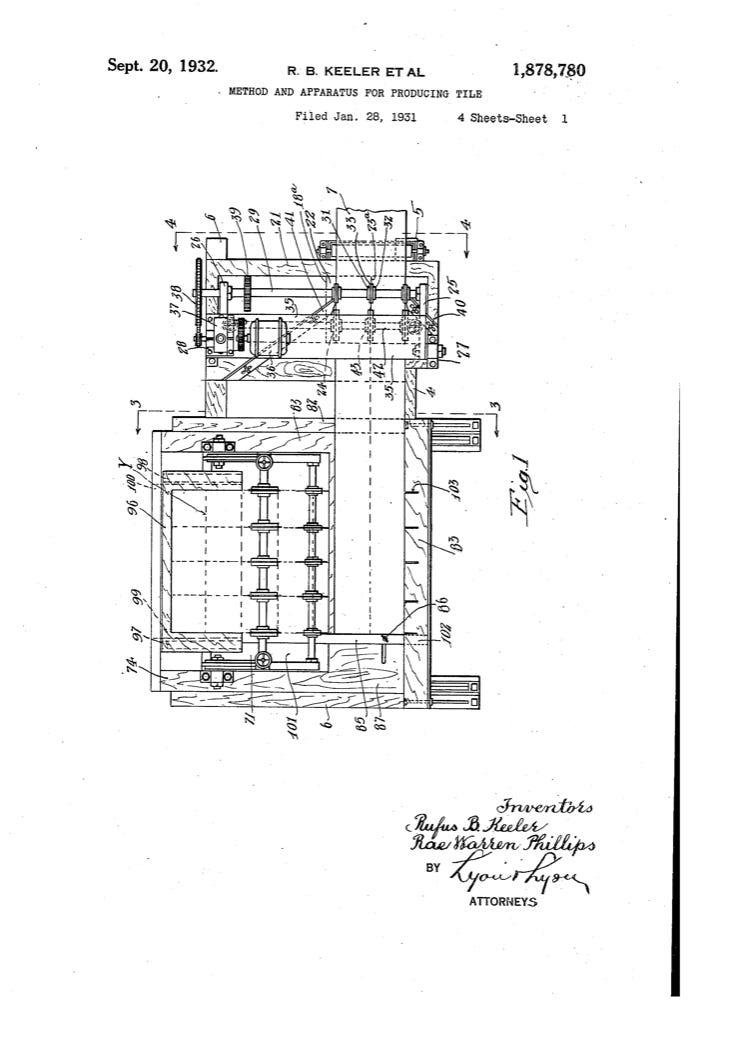
Brad’s first job out of high school, circa 1931, was for Phillips Bronze Bushings, aka Phillips Bronze and Brass and Phillips Bronze and Brass Corp, owned and operated by Rae Warren Phillips. In my research, I have also discovered a patent application filed by Rae Warren Phillips with Brad’s father Rufus, dated January 18, 1931, for “Method and Apparatus for Producing Tile.” So there is some sort of family connection here, but what it is, I don’t yet know.
I do a search of Phillips and the original Oscars and come upon an interview with a man named Jerry Blanchard in The Workshop Book by Scott Landis (Lost Art Press LLC, 2021). He was a high school wood shop and metal shop instructor in Monterrey, California, and while the interview is about tool chests, Blanchard mentions his childhood mentor, Rae Warren Phillips, “the machinist and craftsman who cast the original Oscar awards.”
The is the first and to date only corroboration of the Oscars story outside of my own family.
The official public history of the Oscar is that a young George Stanley, fresh out of art school at Otis Parsons, sculpted the original statuette from a sketch provided by MGM art director Cedric Gibbons. As for who cast the sculpture in bronze, the first of what would be many contracts across the country went to The California Art Bronze Foundry, co-owned by Guido Nelli and a man named Fred E. Keeler.
Hm. Keeler. Coincidence? Probably, though I can in fact trace him back to the family’s common progenitor, Ralph Keeler IV, but from there our lines diverge.
Nelli, the sculptor and artisan behind the foundry, was an Italian immigrant who came to Los Angeles by way of New York via Petrograd, Russia. Trained by Ernesto Biondi in Rome, Nelli introduced the lost wax process of casting metal sculptures to the United States. In 1927, he opened his art bronze foundry in L.A. which, according to the Bowers Museum, was the only foundry specializing in art in the Western U.S. On the Bowers’ website blog, an article titled “The Ungilded Man” notes that when George Stanley was ready cast these new statuette sculptures in bronze, “his only option was to work with Nelli.” Given there is ample evidence of Phillips Bronze and Brass being a going business concern in the same region at the same time, this seems like an overstatement, except perhaps for the “art bronze” designation, which Phillips did not use.

Looking at our photo and comparing it against a published timeline of the Oscar statuettes over the years, I notice that it’s identical to one that Katharine Hepburn received in 1933. Identical. So where was Brad in 1933? He would have been twenty years old. According to voting records, Brad had two years of college, which would make the timing of his first job about right.

It is the following morning and I am thumbing through the album again and find a photo that I’d previously overlooked: three more statuettes, two with engraved plaques that I can actually read:
Academy of
Motion Pictures
Arts and Sciences
First Award
1934
So there it is. Was Brad involved with the production of the first Oscars? Not likely. All sources excluding the anecdotal indicate that Nelli did cast the original Oscar statuette. But given this new information and the date on the statuette in the family album, I think a strong case can be made that Brad was involved in an early iteration, possibly as early as 1933 or 1934. Nevertheless, I keep looking for something definitive, and at last I come upon an article by Chris Nichols of Los Angeles Magazine dated February 25, 2016:
In 1935 the Academy switched to Phillips Bronze Bushing Works near Central and Washington for one year. Then a partnership between Dodge Trophy Company and Southern California Trophy Company made the awards for the next 24 years, crafting them out of plaster during World War II.
Again, the date is a bit of mystery as it doesn’t completely line up so I wrote to Chris Nichols to check his source. He wrote back: That article was almost a decade ago and, I realize the irony of my career asking people to recollect history, but... I can’t remember.
Fair enough.
In another charming photograph, a twenty-something Brad is leaning jauntily against a bronze bust balanced on a sawhorse, his elbow resting on the top of the man’s head, the other hand on his cocked hip, left knee bent, heel raised. He is wearing a fedora, and his expression is casually cool. He is in workman’s dress: long-sleeve cotton shirt with the first few buttons undone to expose the top edge of his white undershirt; loose-fitting trousers, suspenders dangling. The end of the work day. Behind him is a corrugated aluminum wall, a low floral armchair or settee at the edge of the frame. The bust is unquestionably of John G. Bullock, department store mogul. This must be the Phillips’ workshop. So what exactly did Brad do?

To consider this, I must look to the process of creating a bronze sculpture. No way is this a one-man job. A newspaper clipping references a 1938 presentation by Guido Nelli given in Pomona which includes a film of his casting of the Beethoven statue which still stands in Pershing Square, Los Angeles. A boon, to be able to watch the process, and while I can’t find that particular film, another equally informative one pops up. Created by the Metropolitan Museum of Art in New York in 1922, it documents the creation of the Teddy Roosevelt statue by sculptor A. Phimister Proctor using the lost wax process of casting a sculpture in bronze.

It too begins with an initial sketch, then a “thinking it out” phase where the sculptor creates it in miniature out of clay. From there, a larger-but-still-not-full-size plaster model is created for “pointing up” the final full-sized sculpture.
It should be noted that while Proctor is involved with that initial sketch and the small scale model, and of course the final steps as it nears completion, there are many phases in between where the work is done by men who will likely never be recognized.
What does all this have to do with Brad? Well, there are the statuettes, and the Bullock’s bust. And then there are the parrots. But what we don’t know is what part he played in their creation.
The parrots?
Yes.
There are several instances that I’ve run across of life-sized bronze parrots being attributed to Brad Keeler. One example is this:

A listing with Bradford Auctioneers shows a five-foot tall perch and life-size parrot in bronze. It’s attributed to Brad, and signed Phillips. A web search brings up a post from 2007 on Collectors Weekly documenting an exchange between a collector of bronze sculptures and the famed Jack Chipman, who has written many books on American pottery. In the exchange, Chipman notes that after high school, while Brad was taking an evening painting class at USC, he was employed by Phillips Bronze and Brass. The exchange came about after the collector ran across another life-size bronze sculpture of a parrot on a perch that bore similarities to Brad Keeler’s later ceramic figurines of parrots. Chipman’s response? I’m close to 100% certain this is the work of Brad Keeler. It’s quite a find as he was not employed there very long.
While it was many years later, I decided to go ahead and write to Jack Chipman to confirm. He replied that his information came from Great-Uncle Phil. That tracks.
Returning to the question of Rae Warren Phillips’ connection to my family:
Rae Warren Phillips began his career at age eighteen as an apprentice pattern maker, then an iron worker, moving into bronze and brass and becoming an entrepreneur with his Phillips Bronze Corp. Theresa Murphy, a descendant of the Simpson clan recently whom I recently connected with on ancestry.com, confirmed that Rae Warren Phillips is family—through his wife Jennie Belle Phillips. She sent me a genealogy record she put together which traces the lineage: Rufus’s mother’s brother, James Buchanan Simpson, married Mariana Trujillo, a native of Sonora, Mexico, and together they had several children, including Jennie. (Some records say Genevieve, others Joanna, but all confirm she went by Jennie or Jenny). And now it begins to make sense! Aunt Jennie, who was in fact a cousin, was one of the few connections Rufus had to the mother who died when he was a child.
Rufus and Jennie were first cousins. Brad was Rufus’s son. Of course he let him work in the foundry!
The circle starts to close

There is still the mystery about the John G. Bullock bust. Grandma Catherine used to take Mom to Bullocks where they would stop and look at the bust, and she was the one to alert me to the Keeler signature on the back. Lloyd and I took a field trip to what is now a Macy’s where there is what amounts to an homage to the Bullock legacy. We found the bust and pulled it out from the wall to check the signature. It’s there, just as Mom said it would be, signed Keeler Art Bronze Fndy.

But the stubborn fact is that a foundry by that name was also associated with Fred E. Keeler, partner at least for a time with Guido Nelli.
In June of 1934, the widow of sculptor Charlie Russell sued and settled with Fred E. Keeler to have returned several of Russell’s works which were in Keeler’s possession. The documentation states that he was doing business as “Keeler Art Bronze Works” as well as “California Art Bronze Foundry,” Guido Nelli’s operation. In August, Fred E. Keeler filed for bankruptcy, after which he was sued by another sculptor, Atanas Katchamakoff of Palm Springs, for losing the original plaster mold of his “Pregnant Madonna.” The question becomes, were any works ever produced by Fred E. Keeler with the “Keeler Art Bronze” foundry mark? I can find no records. I ask the internet and the answer comes back a resounding no.
I realize the evidence is circumstantial, but the facts remain: Brad worked for Phillips. There is a picture of Brad with the Bullock bust, and the bust is signed Keeler. I can only conclude that Brad had a hand in sculpting the bust.
This is what could be called Brad’s lost bronze period, found. Or, semi-found.
History itself is a game of lost and found. You won’t find Proctor’s Roosevelt statue anywhere, as it was toppled on October 11, 2020, during Indigenous Peoples Day of Rage.
 Bronze sculpture | in Brad Keeler
Reader Comments