Brad Keeler Artwares at Clayton and Hazel Sinclair's Rock Rest Tourist Ho
 Catherine Porter
[Cross posted from Cati's Poetry, Prose & Pottery Substack]
On November 5, 2019, I received an email through the Brad Keeler Artwares website contact form from Carrie Feldman, a cataloger at the Smithsonian National Museum of African American History and Culture. She wrote:
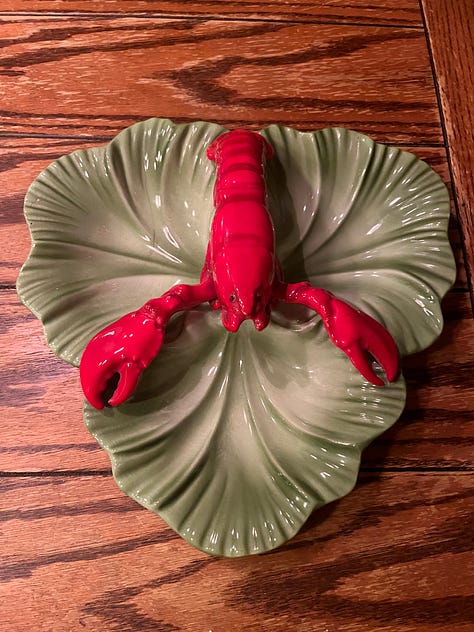
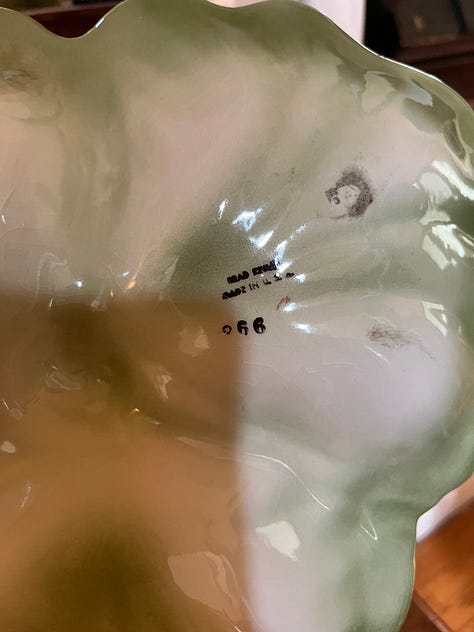
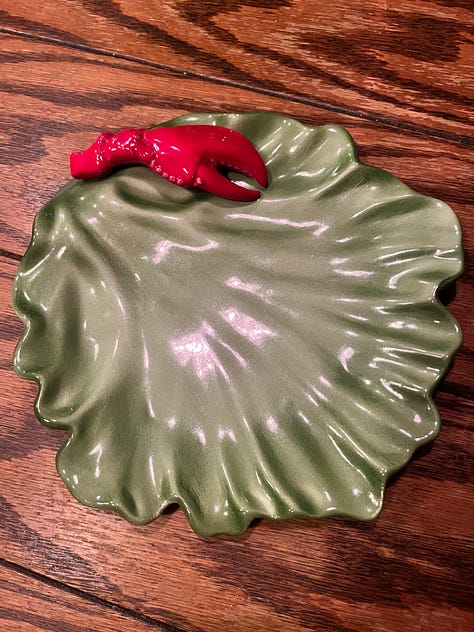
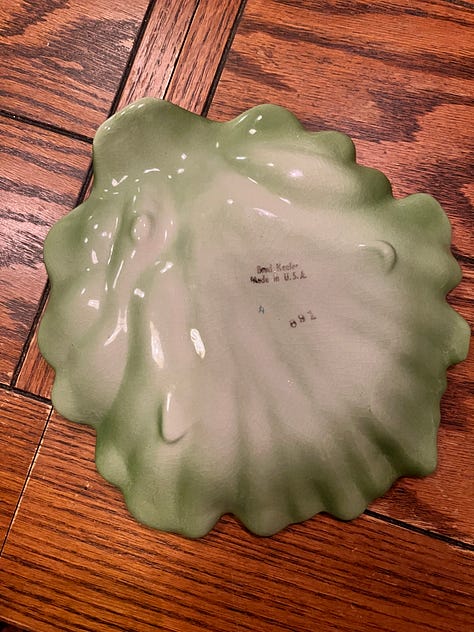
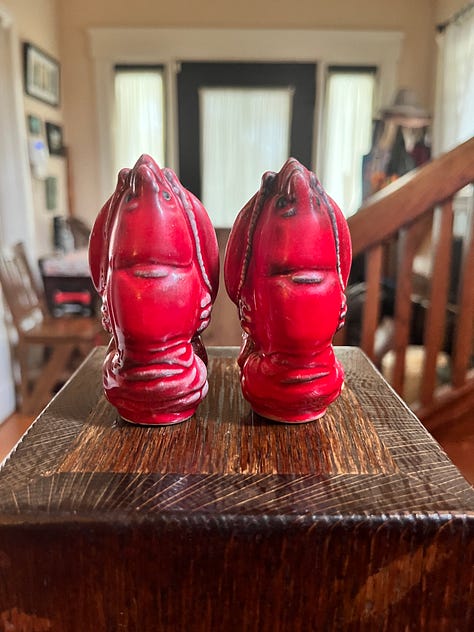
I am currently cataloging a few items created by Brad Keeler, all from his lobster line. I am having trouble dating the pieces. In this collection is a Three Part Divided Dish with a full lobster on three lettuce leaves stamped 866, a small plate with a single lobster claw stamped 891 (I think), and salt and pepper shakers of lobster heads (no stamps but appear to match the plates). Do you have a date range for this line? Thanks!
Whoa! Grandpa Brad’s lobsters in the Smithsonian! I immediately wrote her back:
Thank you for your interest in my grandfather's work. I'm curious to know how the lobster dishes found their [way] to the Smithsonian's African American History museum -- it is an honor to know they are there, and I am delighted to help.
She, too, responded immediately:
The pieces were collected from an African American-owned tourist home that ran during the Era of Segregation in Maine. It was one of the few places where African Americans could vacation during that era. I’ve attached photos (poorly taken from my iPhone and pre-conservation treatment/cleaning). Once I’ve completed the records, these will be public on the Smithsonian collections search page, so I always like to confirm the accuracy. If these pieces have particular names, please let me know. This is what I have currently named them.
-
Brad Keeler three-part divided dish
-
Brad Keeler plate
-
Brad Keeler salt and pepper shakers
Please let me know if there are official names to these pieces or if I have misidentified anything.
Also can you confirm that the three-part divided dish is #866?
And the plate is #891?
I wrote back the next day:
Thanks for your patience. I love that my grandfather's pieces found their way into that home, and hopefully made the guests' stay more pleasant. I can imagine them set out on the table and all the conversations that must have gone on around them. Once the page is live, I would love to have the link so I can share. I'd also like to make people aware of it through the Brad Keeler Artwares website that I run: http://bradkeelerartwares.squarespace.com/
I got out my stepstool to take a look at the pieces I have and I discovered that I don't in fact have exact matches for these, but some research did unearth confirmations that your numbers are correct: 866 for the three-part divided dish and 891 for the plate. As far as I know, the names you have given are what they are usually called, except for possibly adding "Artwares" after "Brad Keeler" ("Brad Keeler Artwares") as that is what appears on the label, when there is a label and not a stamp. You also might consider adding "Lobster" (or Lobsterware) as there are other similar pieces using radishes and tomatoes and crabs; that would differentiate them, and is often how they're described in ebay listings and catalogs. There is no official name for them, as far as I am aware. For a city of origin, you may list Los Angeles, California.
Again, thank you for allowing me to assist you with identifying these pieces. I have not been to the Smithsonian since I was a teenager. Now I have another reason to plan a trip.
She wrote back the next day:
I made your suggested changes – I went with Lobsterware since that sounds like the name of the line. I couldn’t fit it in the object name (character limit) but it’s in the description. But I was able to fit Artwares into the object name. Thank you so much for the additional information and for confirming the numbering on the museum’s pieces. I will let you know when these artifacts go online. It will probably take a little while because it’s a large collection of objects that I’m working my way through and I’m just at the beginning
Your website is very well done, by the way. That’s what I used for your grandfather’s constituent bio and how I found you. I’m also dropping the link for your site in the record for the curator to have a look once it goes to curatorial review.
And if you do come to DC for a visit, please let me know. I’d be happy to get you tickets for the museum!
Our exchange might have ended here, but as it happened, I did find my way to D.C., albeit four years later, and took a chance and wrote to her again hoping that her offer of tickets was still good. I wanted to meet her in person, and I was also curious about the fate of those Lobsterware dishes. Unfortunately, she was out of the office, but the ticket offer was still good and I was happy to get more information about the vacation home:
I can tell you a little bit to start. The Rock Rest Tourist Home was in Kittery, ME. It was owned by a husband and wife during the Segregation Era. It was in the Green Books as a safe place for African American vacationers to go without fear of violence or discrimination. Sadly, after the Sinclairs died, the house fell into disrepair. Eventually a historic preservation organization stepped in and they offered NMAAHC the contents of the house. We made a field collection there which included your grandfather’s pieces. This material was originally collected, not only to preserve this historic house, but also for our exhibition called Power of Place, which is one of my favorite exhibitions and is located on the third floor of the museum down the center. I’m not 100% sure of this, but I believe that since the material was in poor condition and required a great deal of conservation, the curators decided to focus on a different segregated tourist home called Oak Bluffs in Martha’s Vineyard, MA. But here’s a little more information here: https://savingplaces.org/stories/preservation-vacation-rock-rest-a-home-away-from-home
She then sent me the tickets and I enjoyed a long visit in the museum. This was in 2023.
Yesterday, I was thinking about our exchange again because I’m preparing to hand off the final draft of Clay Bodies to the copy editor and I’m thinking about all the people I need to thank. I was curious to see whether those Lobsterware dishes ever made it into the online records. Sure enough, there they were! I decided to drop Carrie another email but got a mailer daemon. I can only assume that she is no longer with the Smithsonian. (Carrie, if you’re out there, send me a note about how I can find you!)
While at the time of our exchange I did not own either the lobster plate or the divided dish, I do now. The Smithsonian entries don’t yet have pictures, but based on the matching numbers, I assume they are identical to the ones below.

Hazel and Clayton Sinclair’s Rock Rest Tourist Home has been written about extensively and is even included in the PBS documentary Driving While Black.
If you’d like to know more, check out the following links:
Click here to read Valerie Cunningham’s first-person account of working at Rock Rest.
Click here to read more Rock Rest Tourist Home history on Route1Views.
Click here to view Rock Rest Tourist Home on the Smithsonian NMAAHC website.
Click here to view all three Lobsterware entries on the Smithsonian NMAAHC website.
Click here to view the Power of Place ongoing exhibit at the Smithsonian NMAAHC website. Note: Rock Rest is not on exhibit.


